
LED vs. Laser: Why Your Face Mask Might Be Lying to You
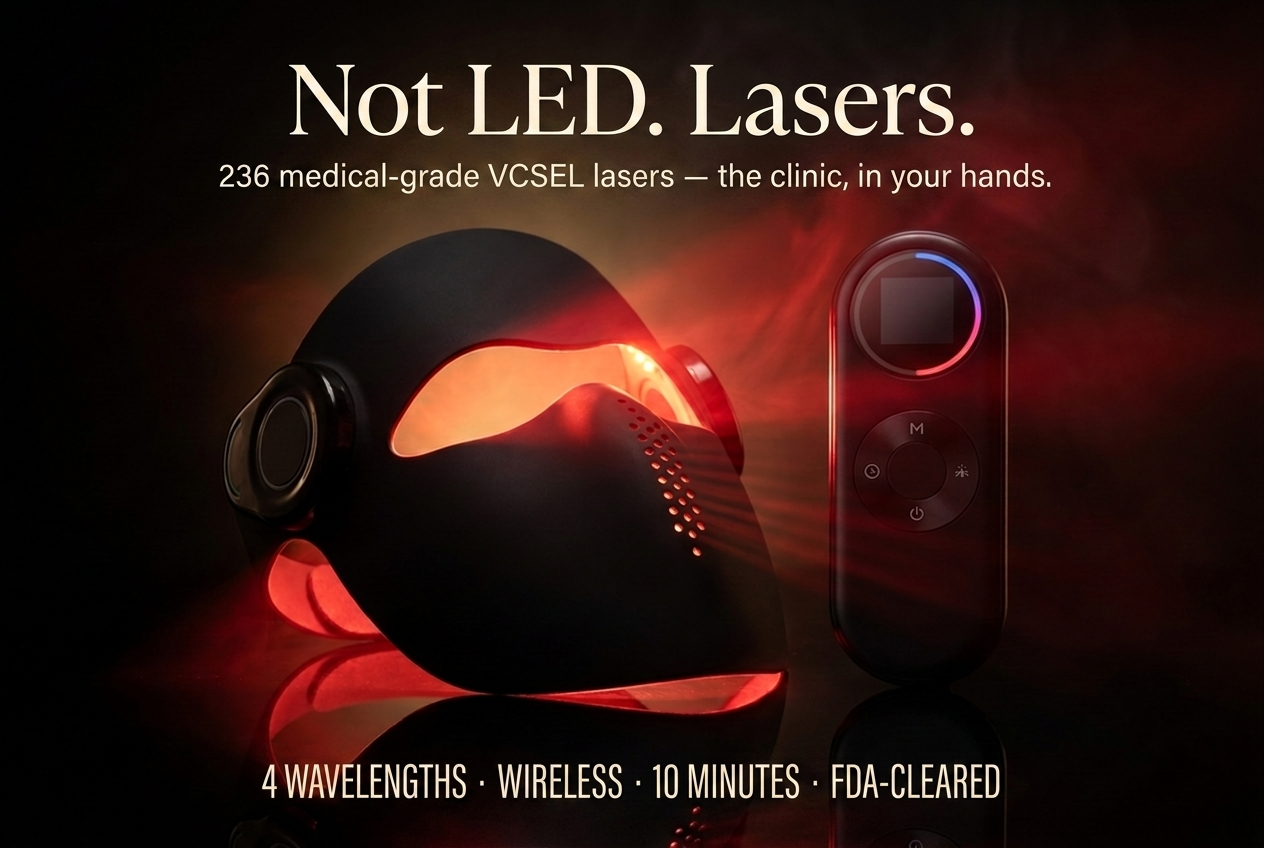
If you own an LED face mask and quietly suspect it isn't doing much, you're not imagining things. Here's the part the beauty industry rarely explains: the type of light matters more than the color of light.
Scattered light vs. aimed light
A standard LED emits incoherent, scattered light. It spreads in every direction and much of it dissipates across the surface of your skin — the top 1 to 3 millimeters. That's enough for a temporary glow, which is exactly what most people report: nice for a day, nothing that lasts.
A VCSEL laser diode emits coherent, collimated light — organized energy moving in the same direction. That structure lets it penetrate deeper, 3 to 10 millimeters, and deliver a higher usable dose in every session. It's the same category of technology behind the devices your dermatologist charges by the visit to use.
Why depth is the whole game
Collagen and elastin are produced by fibroblast cells that live in the dermis — below the surface layer most LED masks ever reach. If the light doesn't get there, it can't stimulate the cells responsible for firmer, smoother skin. Depth isn't a specification detail; it's the difference between a surface glow and a structural change.
How to tell what you actually own
Check the spec sheet for the word laser (specifically VCSEL) versus LED, and look at the wavelengths and irradiance. Higher, coherent output at clinically studied wavelengths — 665nm, 850nm, 1064nm — signals a device built to reach the dermis, not just light up your bathroom.
The Velove LaserPro 4 was built around exactly this principle: three medical-grade VCSEL lasers plus a clinical blue light, in one 40-minute at-home protocol. If you've been disappointed by an LED mask, this is the reason — and the fix.
This article is educational and describes the appearance of skin. Individual results vary.
Beyond LED. This is clinical.
Three VCSEL lasers + clinical blue light · 90-day results guarantee · from $84/mo
Shop the LaserPro 4